For us, life has become a continuous race, measured not by milestones of inner peace or by alignment with natural law but by the frantic rhythm of external demands. We live in an age of pervasive noise and relentless activity. With social comparison, professional obligations, and the sheer speed of modern existence, we often discover that we have lost our JOY. We look inward and find an empty well, wondering how an excess of baseline “busyness” dried up our vitality.
When joy vanishes, our immediate instinct is often to look for a quick psychological pivot or a temporary escape. Yet, a deeper examination reveals that sustainable joy is not an emotional state we can summon at will. Instead, it is a natural consequence of structural alignment. The human self relies on an ecosystem of foundational pillars. When these elements are in balance, joy appears naturally. When neglected, the architecture of our inner life begins to fracture.
The Triadic Architecture of Self
To understand how to reclaim joy, it is useful to visualize well-being as a triangle. At the absolute apex sits Joy—not as a transient spark, but as the stable crown of a balanced life. Supporting this apex is the internal framework of mental and emotional health. But these interior spaces do not float in a vacuum; they rest upon a broad, firm foundation composed of three distinct realities: the Spiritual, the Physical, and the Financial.
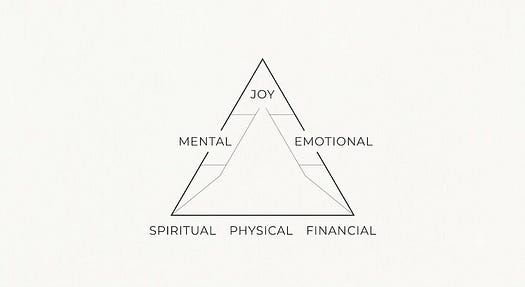
This structural approach is deeply rooted in natural law—the understanding that human flourishing requires following our inherent design. Joy requires a solid foundation. If the base of our personal ecosystem fractures, the middle mental and emotional health will inevitably sag, pulling the apex down with it. Reclaiming joy is not an act of dreaming; it is a deliberate project of systemic realignment, beginning at the primary foundation of the self.
1. The Spiritual Foundation: Radical Gratitude and Universal Order
Under natural law, spiritual health is the practice of aligning oneself with the deeper, quiet order and recognizing our place within a larger collective. It is the foundation upon which all other pillars rest. When we slow down enough, we access a deep, universal truth: human beings thrive through altruism and connection. Utilizing our innate personal gifts to serve our local community—whether through public speaking, mentoring, volunteering, parenting, writing, or cleaning—is an act of universal alignment. This outward stewardship reminds us that we are part of a supportive web larger than ourselves.
A vital part of this spiritual alignment is radical gratitude. In natural law, gratitude is a powerful cognitive and emotional harmonizer. Choosing gratitude—even when feeling a deep sense of lack or an emotional void—is a practical step that re-anchors the mind. By deliberately focusing on the foundational love that preceded us, we build the inner scaffolding needed to endure tough times.
“Gratitude is not just a social virtue; it is a profound neurological mechanism that shifts our nervous system from a state of threat and lack to a state of safety and connection,” says Dr. Robert Emmons, a professor at the University of California. “When we practice gratitude, we align our internal chemistry with the natural evolutionary laws of human bonding and resilience.”
2. The Physical Foundation: Nurturing the Vessel
Parallel to the spiritual baseline is the physical foundation. Human beings are integrated organisms; the mind and body are profoundly interconnected. Physical maintenance requires deliberate wisdom: eating intentionally to manage body weight and moving with purpose. Consistent movement—whether running across open paths, walking through changing landscapes, or working out to build resilience—is for mental stability.
However, living by natural law also means acknowledging our stark biological limitations. When systemic fatigue or illness strikes, it can become our greatest area of struggle, leading to profound frustration. Coping with these physical boundaries requires us to set aside the modern pressure. It forces us to form a resolute “board of directors” or care team to heal us.
“The mind and the body are not separate entities; they are deeply integrated systems,” says Dr. Bessel van der Kolk, Boston University professor. “Physical movement, structural care, and somatic maintenance are not merely about athletic performance—they are the foundational baseline required to regulate our nervous system, reduce emotional inflammation, and sustain psychological resilience.”
3. The Financial Foundation: Ordering Daily Resources
The final pillar of the base is financial health. Harmony requires order across all areas of life, including how we manage our practical resources. Financial stress is a profound source of nervous system deregulation. When resources are chaotic, it creates a persistent background noise of anxiety that directly degrades our emotional stability.
True financial stewardship means bringing discipline and visibility to our daily habits to create safety and predictability. By ordering our material world, we protect our mental and emotional space from unnecessary friction.
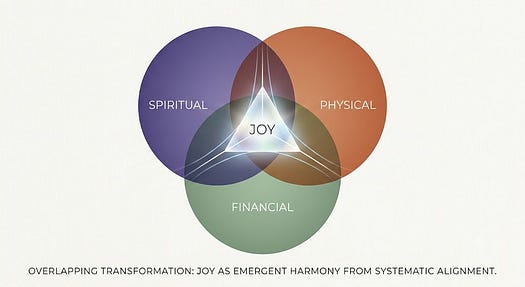
The Interconnected Return to Joy
Changes in one pillar directly affect the others. When we systematically organize our finances, we lower our baseline anxiety. When we quiet our minds in reflective service and gratitude, we reduce internal tension. When we care for our bodies through movement and therapeutic support, we generate the biological energy needed for deep mental presence.
This systemic approach reshapes our purpose. When our foundational health is strong, we can navigate career choices and institutional transitions with clarity rather than desperation. Decisions about our professional futures—whether evaluating long-term roles, networking with colleagues, exploring new professional paths, sharing a story, or getting organized—can come from a position of inner security. We look for authentic alignment because we are no longer managing internal crises.
Ultimately, reclaiming our well-being requires a fundamental shift in perspective. We must embrace a vital truth: self-care is not selfish. Caring for the spiritual, physical, and financial aspects of our lives is a fundamental responsibility to the natural order. It is our lives. When we build and keep a healthy, healed foundation, we stop straining for happiness. Joy is no longer an elusive goal we must chase; it becomes the natural, inevitable expression of a well-aligned life.

 Michael Lerchenfeldt
Leave a comment